środa, 7 listopada 2018

MADELINE IN PARIS

   Recently my friend asked me to recommend a book about school children to him. The first book that came to my mind was "A Little Princess" by F.H. Burnett. It is one of my favourite books but may not be suitable for a seven year-old girl who is just learning to read. Then I started to search on the Internet and found "Madeline w Paryżu" (Eng. Madeline in Paris) written and illustrated by Ludwig Bemelmans, an Austrian-American children' author.
   The action of the book takes place in a Catholic boarding school in Paris, France. Madeline is the smallest of the girls. She is seven years old, and the only redhead. She is the most daring and often gives Miss Clavel a headache as she gets into a lot of trouble.
   "Madeline w Paryżu" is a collection of all six stories written by Ludwig Bemelmans:
  • Madeline, 1939: in which Madeline has her appendix removed.
  • Madeline's Rescue, 1953: in which Madeline is rescued from drowning by a dog - later taken by the girls and named Genevieve. 
  • Madeline and the Bad Hat, 1956: in which the "bad hat" is Pepito, the Spanish ambassador's son, who is a very naughty boy.
  • Madeline and the Gypsies, 1959: in which Madeline and Pepito have an adventure at a circus.
  • Madeline in London, 1961: in which Pepito moves to London, and Madeline and the girls go to visit him.
  • Madeline's Christmas, 1965: in which everyone in the house catches cold, except Madeline. 
Each story begins with the same rhyme:
In an old house in Paris
That was covered in vines
Lived twelve little girls
In two straight lines.
The last chapter is dedicated to the origins of Madeline. It also contains a selection of original sketches from the author's notebooks.

Madeline w Paryżu by Ludwig Bemelmans


niedziela, 4 listopada 2018

THE MAGIC FARAWAY TREE

   "The Magic Faraway Tree" is the second story in the Faraway Tree series by Enid Blyton, the children's author. The book was published in 1943 and had many later editions. When I started to look for the book on the Internet and saw pictures of early editions illustrated by Dorothy M. Wheeler and I understood that I had to buy one of them. I was really lucky to find the edition from 1968 on Allegro. The book is in quite good condition except for the dust jacket that is torn at the edges.
   The story begins when Dick (renamed Rick in later editions) comes to stay with his cousins Jo, Bessie and Fanny (renamed Joe, Beth and Frannie in later editions). The children share their secret about the Faraway Tree and its extraordinary occupants with Dick. Soon the whole party visits Moon-Face, Silky and Saucepan Man to find out which new land is at the top of the Faraway Tree. The first land they enter is the Topsy-Turvy land. It is a peculiar place where everybody walks on their hands and everything is upside down. After Jo makes a policeman angry, he is forced to stand on his hands due to a spell the policeman puts on him. His companions search for help in the Land of Spells. There they meet many witches and wizards who are selling their spells and ask a friendly old witch to put Jo the right way up again.
   The children visit many other lands such as the Land of Dreams where everything that happens is  dream-like and unreal. They get stuck in this land for some time because the Sandman scatters sand in their eyes to make them sleep. In the Land of Do-What-You-Please anybody can do what they want and the children have great fun. Jo gets to drive a train, and all of them get to paddle in the sea. In the Land of Toys, Saucepan Man gets imprisoned for stealing sweets because he mistook this land with the Land of Goodies. Happily Jo and the others rescue him from jail.
   Enid Blyton created a magic world full of peculiar creatures with funny names such as Dame Washalot or Mister Watzisname and unusual places that the children visited. It is a world of children's imagination where anything can happen and where the usual things become the most unusual.
   I enjoyed the book very much. I laughed a lot and couldn't wait to find out what was going to happen next. I wish I could be there with Jo, Bessie, Fanny and Dick to climb the Faraway Tree and have the extraordinary adventures with them.

The magic faraway tree by Enid Blyton


wtorek, 23 października 2018

DUSZAN

   "Duszan" written by Antonina Todorović is a book that caught my attention when I was looking at the list of "10 books that are worth taking on holiday with a child" published by Newsweek. The mysterious title and the amazing cover with an old house and a bear encircling the top of it convinced me to buy that book. Soon it was in my hands. The hard cover, the yellowed pages and many beautiful illustrations by Dorota Wojciechowska confirmed that I made the right choice.
   Duszan and Janek are brothers who live in the city. Their parents work a lot and they rarely spend time with them. Right at the beginning of the summer, the boys go to their grandmother, who lives in the countryside. Zalesie turns out to be a magical place that allows them to have extraordinary adventures. They meet Mr Śmiejko, who is a good friend of their grandmother. He lives deep in the wood and is taking care of sick animals. He helps the boys to build a small wooden house. Janek learns how to ride a donkey and Duszan becomes friends with a grey wolf. They find the lake from Duszan's dream where the time passes very slowly and also meet the Silver Bear who makes the time go faster. 
   When I reached to the end of the book I felt slight degree of disappointment. The story had everything to make it special but I felt that something was missing. The characters were as they should be, the adventures were interesting but somehow they didn't move my heart the way I expected. Despite my negative feelings I believe the book is worth reading as it touches on important subjects such as raising children. Parents should spend more time with their children, support them in their interests and talk about their feelings.

"Duszan" by Antonina Todorović


środa, 10 października 2018

MARIA KONOPNICKA

   Maria Konopnicka was a Polish poet, children's writer and activist for women's rights and for Polish independence. She used many pseudonyms, including Jan Sawa. She made her debut as a writer in 1870 with the poem "W zimowy poranek" (Eng. On a Winter's Morning). Her most famous pieces of children's literature include "O krasonoludkach i sierotce Marysi" (Eng. Little Orphan Mary and the Gnomes), "Co słonko widziało" (Eng. What the sun has seen) or "O Janku wędrowniczku" (Eng. About Janek the wanderer).
   When I was a child my mum bought me the poem "Na jagody" (Eng. For blueberries). The book became one of my favorites but unfortunately it did not survive my great interest. Some time ago I decided to look  in antique shops for the edition I had with illustrations by Anna Stylo-Ginter. It took me a while but finally I found the book in quite a good condition. The poem is about a little boy, who wanted to gather some blueberries in the forest for his mum. He couldn't find any fruits and decided to rest on a tree-trunk. He then saw the Blueberry King who invited him to his house. Janek met there seven blueberry brothers who helped him to gather a basket full of blueberries. Then they visited Mrs. Governess and her five bilberry maids. The girls helped Janek to gather a basket full of red bilberries. After this he woke up on the tree-trunk and noticed that both his baskets were full of berries. He wasn't sure if his extraordinary adventure was real or just a dream.


"Na jagody" by Maria Konopnicka


     The other book that I have with poems by Maria Konopnicka is "Moja Książeczka" (Eng. My book). It is a reprint of the first edition from 1891. The book has wonderful illustrations by Harriet Bennett. It is a collection of short poems about little children.


"Moja książeczka" by Maria Konopnicka


piątek, 28 września 2018

TASHA TUDOR

   I discovered Tasha Tudor while looking for garden inspiration on Pinterest. I found many pictures with Tasha taking care of her wonderful garden. She was almost always alone and she didn't look at the camera. I started to look for some more information about this intriguing person. I discovered that she had four children and it was her choice to live alone, but what's even more interesting is that she was an illustrator and writer of children's books ;) She resided in New England from her birth on August 28, 1915 in Boston, Massachusetts to her death in Marlboro, Vermont on June 18, 2008.
   I started to look for Tasha's books but quickly discovered that none of them have been translated to Polish. Fortunately many online stores offer free delivery worldwide. One of the cons is the waiting time, which can take up to several weeks but this a sacrifice that a true book-lover will bear with dignity.
   The book I bought "A Time to Keep" was published in 1977. The story starts with a question "Granny, what was it like when Mummy was me?" asked by a little girl to her grandma. The answer is a journey through memories of holidays past. There were homemade valentines and Easter eggs, Fourth of July picnics and family birthdays. Thanksgiving brought visits from relatives so numerous, the children had to sleep in the barn. And finally there was Christmas, the best of all "times to keep" with handmade presents, Advent calendars, and a "beautiful tree in a shine of candles". The book is gorgeously illustrated with watercolor paintings. 
   The world created by Tasha is idyllic, both in her illustrations and in the way she lived in her house with the garden. This greatly conflicts with the fact that she disinherited three of her children in her last will and now they fight over her estate. The sad truth is that Tasha lived in a fantasy world and didn't face real life issues. Some of the last words Tasha said to her daughter Bethany Tudor were: "Oh, will there ever be a cat and dogfight when I die. But I don't care. I won't be here to see it." I suppose a loving mother wouldn't let that happen but I don't know the circumstances to judge Tasha.

Tasha Tudor
A Time to Keep by Tasha Tudor


środa, 5 września 2018

ZERO WASTE

   The "Zero waste" movement has become a popular trend in the past few years. It is a philosophy that encourages people to redesign their way of managing resources according to the Five R’s, in the following order:
  • Refuse what you do not need.
  • Reduce what you need.
  • Reuse by using reusables.
  • Recycle what you cannot refuse, reduce, or reuse.
  • Rot (compost) the rest.
  
"Pokochaj swój dom" by Bea Johnson
   Bea Johnson, who is a practitioner of a zero waste lifestyle, transformed her family's health, finances, and relationships for the better by reducing their waste to a half liter per year. Her book "Pokochaj swój dom" (Eng. Zero Waste Home) shows how the five key principles can be applied to every area of our house from a kitchen to a kids' room. It delivers easy tips for all of us: from buying in bulk and clever meal planning to simply refusing unwanted freebies and using our plants as air fresheners. Bea Johnson shows, by inspiring example, what green living looks like and offers a practical, step-by-step guide to diminishing our environmental footprint and improving our lives.
   The idea of zero waste sounds like a perfect plan for managing items that we use everyday. It can help to gain control over the things that we keep in our houses but also to improve our health, save money and time. It is no surprise then that I wanted to apply some of Bea's advise to my life. The first thing that I  tried was the recipe for liquid soap. I had many small bars of soap which were free samples. I grated 120 grams of them and poured into 1,2 liters of warm water. I left the mixture in a bowl for the whole night and in the morning I found that it turned into white jelly. I added some additional water, mixed it and poured it into a soap dispenser. Unfortunately the soap is sticky and unpleasant to use... and I produced at least a three-month supply... :(

Three jars of home-made liquid soap

   The unsuccessful experiment with liquid soap did not discouraged me from further implementation of zero waste rules. When I noticed aphids on a plant I bought two weeks earlier I already knew that I will try some ecological methods to get rid of them. I found a recipe for an onion and garlic extract on a website of organic gardening. I took one onion and two cloves of garlic and cut them into pieces. Then I threw them into a pot and poured in one glass of water. I boiled the onion and garlic for half an hour while the wonderful smell spread all over my flat :) When the mixture cooled down, I poured the liquid into the spray bottle and sprayed the plant twice with a 2-day break. Unfortunately it didn't work and even made things worse as more aphids appeared on my plant :( Then I tried another domestic method and prepared a mixture of 50 ml vinegar, 100 ml water and a few drops of dish soap. I sprayed my plant with the new cure and it worked partially. The population of aphids has been reduced but the mixture hurt the plant as its leaves turned brown :( I can still try some other natural methods like tobacco or nettle extracts but I'm afraid that the results will not be any better. I decided to leave my plant alone for a few days and when its condition improves I will go to a garden store and buy a professional pest remedy.

The aphids
The plant after the treatment
   I'm a little bit disappointed with the implementation of zero waste to my life. The domestic methods were not efficient and in fact I wasted more - time, money and energy on trying solutions that did not work. It does not mean that zero waste cannot succeed but we need to invest a lot of effort (time and money) to get the first benefits.


poniedziałek, 27 sierpnia 2018

SHINRIN-YOKU

   Shinrin-yoku is a term that means "taking in the forest atmosphere" or "forest bathing." It was developed in Japan during the 1980s and has become a popular method of preventative health care and healing in Japanese medicine. The idea of shinrin-yoku is about walks in a natural area to relax, calm down and revitalize. Dr Qing Li who is one of the world's top experts in shinrin-yoku shares his experience and results of scientific studies in his book "Shinrin-Yoku: The Art and Science of Forest Bathing". The scientifically-proven benefits of shinrin-yoku include:
  • Boosted immune system functioning, with an increase in the count of the body's Natural Killer (NK) cells.
  • Reduced blood pressure
  • Reduced stress
  • Improved mood
  • Increased ability to focus
  • Accelerated recovery from surgery or illness
  • Increased energy level
  • Improved sleep
   The results of shinrin-yoku are impressive and we can easily apply some of the rules to our regular practice even when we live in the city:
  • Every day spend time (30 minutes at least) around trees in the nearby park
  • During the walk try to calm your mind by listening to trees rustling and birds singing 
  • Decorate your balcony or terrace with plants
  • Fill your home with house plants 
  • Vaporise essential tree oils
   I like to visit Park Tarnogajski in my neighborhood. A lot of old trees grow there that create a nice atmosphere. The park was created with funds from the Wrocław Citizens' Budget and opened officially in May 2018. I often visit the park with my kids during the weekends. They ride their bikes and I sit on a bench with a book in my hands ;) In regards to my apartment I have many plants already and I use tree oils (especially pine oil) during hot baths in the winter. The main rules of shining-yoku have already been present in my life for a long time but now I discovered how important they are and what a great impact they have on my health.

Shinrin-yoku by Dr Qing Lee
Park Tarnogajski in Wrocław


GOLDILOCKS AND THE THREE BEARS

 
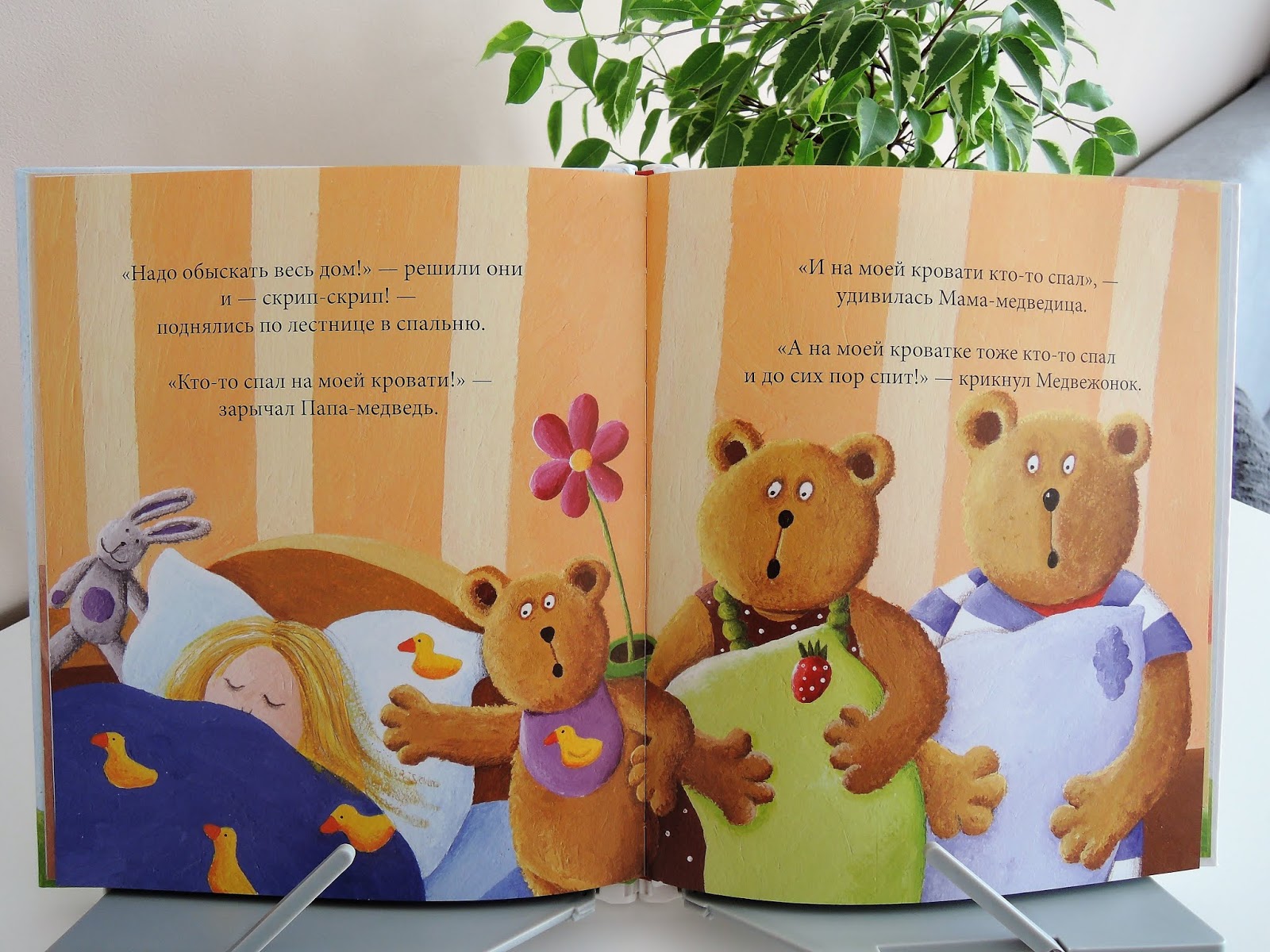
   There are many old stories that are known worldwide but they differ from country to country. When my daughter was a baby I bought her the "Goldilocks and the Three Bears" book. It has hard pages and touch and feel fabric elements to encourage children to play with the book. The story is about a little girl who went for a walk in the forest and came upon a little wooden house. She knocked, when no one answered, she walked in. She noticed three bowls of porridge on the kitchen table and because she was hungry she ate everything from the smallest bowl. Then she wanted to rest and sat on the smallest of three chairs but she broke it. At last she felt sleepy and laid down in the smallest of three beds. While she was sleeping the three bears who lived in the house came back and noticed that someone had been to their house. They found an empty bowl, a broken chair and a little girl sleeping in the bed. "They growled and shouted as they chased naughty Goldilocks out." That's how the story ends in the English book.


   My friend who comes from Ukraine brought me the "Маша и Три Медведя" (Eng. Masha and the Three Bears) book from her last visit to her family home. The book is in Russian and you can find many elements from Russian and Ukrainian culture inside. The family of bears is smiling to you from the cover but it is easy to notice that daddy bear is dressed in Russian national colors (he wears a shirt in white and blue stripes and a red scarf) and has a hat in Ukrainian national colors (blue and yellow). The girl's name is Masha and it is a typical Russian name. Masha just like in the English story found a house in the wood, ate porridge, broke a chair and fell asleep in the smallest bed. The three bears found the girl in their house but instead of yelling they explained that it is rude to enter someone else's house without an invitation. Masha asked them for forgiveness and explained that she was looking for someone to play with. The little bear wanted to play hide-and-seek with Masha but it was already late. Mummy and daddy bear said that Masha should go home now as her parents might be worried. They blessed Masha and wished her a safe journey home.


   I was looking for a Polish version of the story on my book-shelf but I couldn't find one. I will definitely put it on my wish list ;) I'm very keen to check if there would be any Polish aspects in the story.

środa, 25 lipca 2018

TREE CHANGE DOLLS

   Two years ago my sister-in-law was frustrated when her daughter asked her to buy a Monster High doll. She refused to such a doll as she thought it was not appropriate for a seven year old girl. The Monster High dolls are teenagers but they look like prostitutes. They have full makeup, wear provocative clothes and extremely high heels. Sonia Singh, who has two little daughters, also didn't like the look of dolls nowadays. She decided to restyle the dolls to give them the look of young girls. She repainted their faces to have a more childish look, combed their hair into pony tails or braids and sewed them new clothes. Sonia shared the results of her work on Facebook and she received very positive feedback from mums from around the world. She branded her restyled dolls "Tree Change Dolls" as the first photos of the dolls were taken on a tree in her garden. Currently Sonia shares her experience of doll restoration on her web page and encourages parents to provide their children with more appropriate dolls. She would also like to affect toy manufacturers to rethink the type of dolls they produce.
Tree Change Dolls by Sonia Singh

   Some time ago when I saw a Barbie doll in a second hand store I decided to buy it and give her a second life. I shared the idea of saving the poor Barbie with my daughter and she liked it very much. First we washed the doll in warm water with fabric softener. Then we detangled her hair with a brush and made her two braids. Next I slightly repainted her face - changed the lip color to be more natural and made the eyebrows a little bit thicker. Finally I sewed her a dress from a piece of my daughter old clothing. I believe the result of our work is quite impressive. Now our Barbie looks like a happy teenager and my daughter loves to play with her. 

Our Barbie "before and after" transformation
   The best thing about restoring our Barbie is that I spent a great time with my daughter. Now she is asking me to buy another doll to restore it ;)

piątek, 13 lipca 2018

SOUVENIRS (NOT) MADE IN CHINA

   At the beginning of June I went on vacation with my family to Niechorze which is on the west coast of the Baltic Sea. We spent ten days having a wonderful time there. The weather was perfect and the beach was not overcrowded because it was before the peak season. However the local sellers noticed the increased number of tourists and began to open stalls with souvenirs. They were located along the path to the beach and every time we passed by them my kids asked me to buy something. My daughter even made a list of things that she wanted me to buy her for the day i.e.: an ice-cream, waffle or toy-seal. To minimize the risk of buying useless or poor quality things it's good to choose them from the following categories (all verified by us):
  • Books - No matter how many books you have at home it is always worth taking the opportunity to buy a new one ;) After finishing the last of my books on the third day of our stay this year, I decided to look for a new one in the nearby book outlet (for sure I will not make this mistake next year). The prices were low but it was hard to find a decent book as I'm not a fan of romances, thrillers or guides. Eventually I bought "Efekt Domina" (Eng. Domino Effect) written by Dominika Kulczyk with 75% discount.
  • Jewellery - In almost every seaside town you can find stores with jewellery made by Polish jewelers. Last year I bought silver earrings that I often wear to work. This year I bought a silver locket for myself and a heart-shaped pendant made of pink quartz and a bracelet with amber beads for my daughter. 
  • Accessories - Two years ago I bought a grey leather bag with a fringe that became my favorite and despite the passage of time it kept its appearance. You can also buy a leather wallet or a scarf but you should avoid buying another key-chain or fridge magnet as you probably already have a drawer full of them. 
  • Toys - It is really hard to avoid buying toys when your kids have a chance to look at them each time you go to the beach. Most of them are made in China and their quality is very poor. Last year I bought an Elsa doll for my daughter but even though it looked nice in the box the quality was tragic. The doll dress tore up on the first day, then she began to lose her hair and finally she broke her arm... We had to say goodbye to our Elsa and throw it into bin :( This year to minimize my kids temptation and avoid bad quality things I bought new toys before our holiday: a kite from Decathlon and a family game Dobble. My kids were happy with the new toys and during the holiday I bought only a toy-seal for my daughter and a wooden train for my son.
   The best souvenirs that we brought back from our holiday were memories of nice moments that we had together: long walks along the seaside, building sand castles, eating chocolate ice-creams or looking at a seal that was laying on the beach. We took kids on a narrow-gauge railway ride to Trzęsacz, where you can see the ruins of a church from the 14th century. We also visited Muzeum Rybołówstwa w Niechorzu (Eng. The Fisheries Museum in Niechorze). I took a lot of pictures and I plan to print and put them into our family album so that we will recall our memories during the cold winter evenings.

Walk by the beach at sunset

The grey seal

The ruins of a church in Trzęsacz